Authored By: Varshini S
Dr MGR Educational and Research Institute, Chennai
INTRODUCTION
In February 2024, the official social media account of the All India Anna Dravida Munnetra Kazhagam broadcast an audio clip of J. Jayalalithaa, the former Chief Minister of Tamil Nadu who died in December 2016 delivering a political speech she never recorded. The clip was generated using artificial intelligence, without the knowledge or consent of her estate. Within the same electoral cycle, an AI-generated video of the late M. Karunanidhi was deployed for campaign purposes.[1] Neither incident produced an enforceable legal remedy, because Indian law offers none. The moment a public figure dies, the personality rights that courts would have protected in life simply cease to exist.
In Krishna Kishore Singh v. Sarla A. Saraogi & Ors., the Delhi High Court held that privacy, publicity, and personality rights are personal to the individual and do not descend to heirs.[2] That ruling sits in uncomfortable tension with a parallel line of decisions that have issued sweeping injunctions protecting living celebrities against AI voice-cloning and deepfakes.[3] What the courts protect today evaporates the moment the rights-holder dies. Generative AI has turned this doctrinal gap into something commercially lucrative and politically dangerous.
This article argues that India requires a dedicated statutory framework for postmortem personality rights, calibrated specifically to address AI-generated exploitation. Part II examines the existing legal framework and its central limitation. Part III analyses how generative AI transforms that limitation into an acute problem. Part IV surveys comparative legislative responses and proposes a concrete reform model. Part V concludes.
THE LEGAL FRAMEWORK AND ITS FATAL LIMITATION
India has no dedicated personality rights statute. Courts have built doctrine from three sources – Constitutional, statutory, and tortious. It is worth noting that none conceived with posthumous AI exploitation in mind. The constitutional right to dignity under Article 21, as elaborated in K.S. Puttaswamy v. Union of India, provides the broadest foundation.[4]
Performer protections under Sections 38 and 38A of the Copyright Act, 1957, originally conceived for live performance contexts furnish a more specific statutory base.[5] The common law tort of passing off supplies the residual remedy where commercial misappropriation can be established.
The 2022-2025 wave of AI-era litigation has significantly developed this doctrine for living celebrities. In Amitabh Bachchan v. Rajat Nagi, the Delhi High Court restrained AI-based misuse of Mr. Bachchan’s persona across digital platforms.[6] In Arijit Singh v. Codible Ventures LLP, the Bombay High Court restrained AI voice-cloning, characterising a performer’s voice as a commercially protectable attribute unique to that individual, an asset, in effect, that belongs to no one else.[7] In Asha Bhosle v. Mayk Inc., the court barred an AI platform from cloning her voice without consent, holding that it exploited her identity and violated both her personality rights and her moral rights.[8]
Every one of these protections evaporates at death. Section 38A of the Copyright Act, 1957 protects a performer’s moral rights against distortion, but only while the performer lives.[9] The provision says nothing about what happens once the performer dies and that silence is the problem. The deceased public figure’s identity enters a legal vacuum: available to be synthetically revived and politically weaponised, with no enforceable remedy for surviving heirs.
The constitutional question of whether personality rights are descendible remains open which makes legislative intervention both necessary and immediately available as a remedy.
III. GENERATIVE AI AS THE CRITICAL AGGRAVATOR
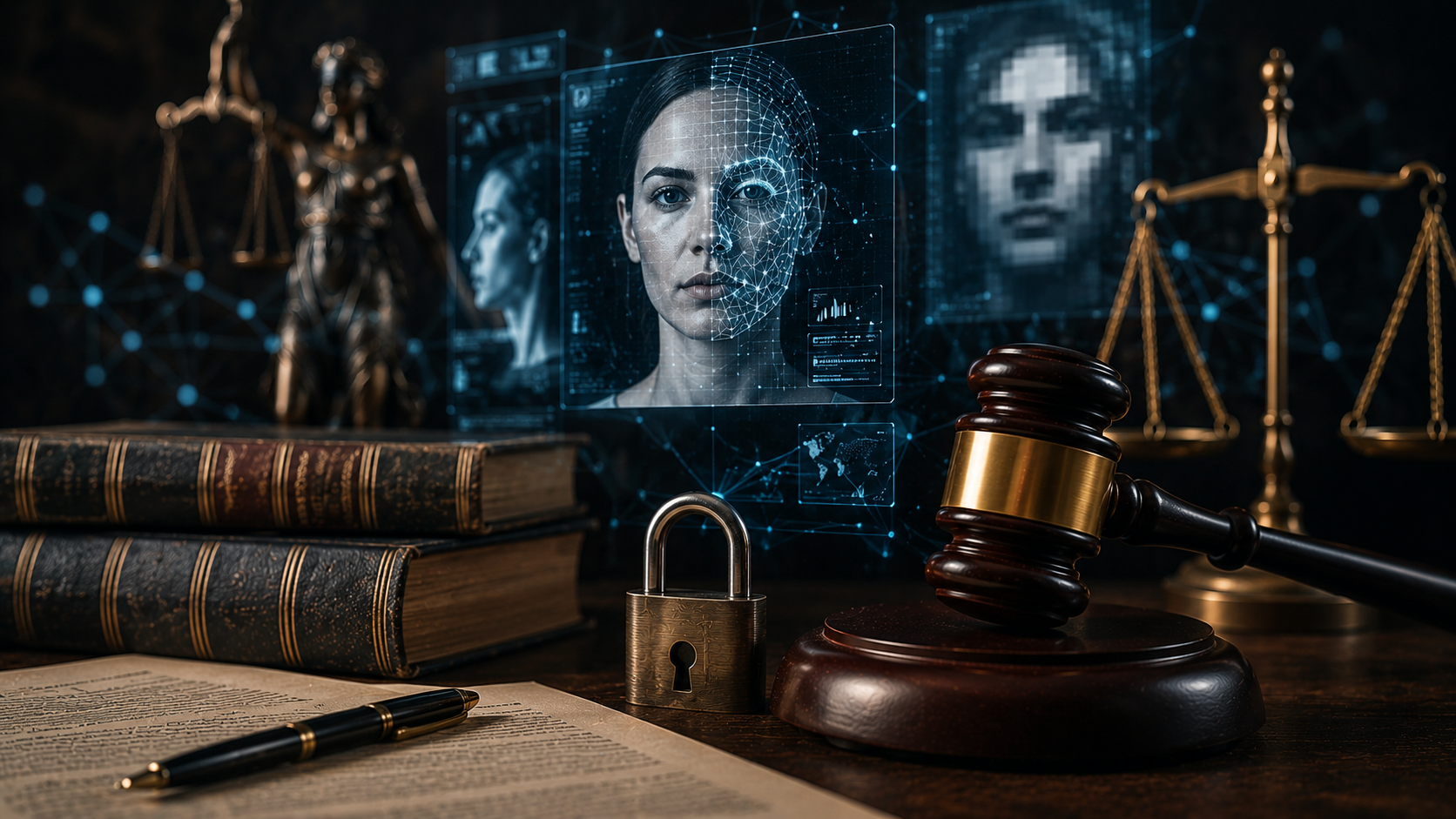
Generative AI has demolished the practical barriers that previously constrained posthumous exploitation. A voice cloning tool needs only a few minutes of publicly available audio to produce a convincing replica. Deepfakes go further. They can animate archival footage and put entirely fabricated words into a dead person’s mouth. The commercial logic here is one-sided to the point of absurdity, a deceased celebrity cannot pick up the phone to a lawyer, cannot issue a denial, cannot sue.
The regulatory architecture offers no adequate response. India’s Information Technology (Intermediary Guidelines and Digital Media Ethics Code) Rules, 2021 require platforms to act against deepfakes,[10] but impose no liability on the AI developer who creates them. The Digital Personal Data Protection Act, 2023 protects biometric data of living individuals but is simply silent on the dead.[11] The World Economic Forum’s Global Risks Report 2024 identified AI-generated deepfakes among the No.1 short-term global risk.[12] A framework designed entirely around the living cannot reach this problem.
COMPARATIVE ANALYSIS AND THE INDIAN REFORM IMPERATIVE
The international response has moved decisively. California amended its Astaire Celebrity Image Protection Act in 2024 to encompass AI-generated digital replicas of deceased celebrities, creating civil liability for commercial use without estate consent.[13] New York’s Right of Publicity Act recognises postmortem rights for deceased performers, including protection against synthetic deepfakes.[14] The proposed NO FAKES Act would establish a nationwide right over AI-generated replicas with a seventy-year postmortem duration.[15] The European Union’s Artificial Intelligence Act (2024) imposes transparency obligations on systems generating synthetic likenesses.[16] Each of these instruments addresses precisely what Indian law ignores.
It is submitted that India requires a dedicated postmortem personality rights provision inserted within Chapter VIII of the Copyright Act, 1957, the existing performer’s rights framework, as the appropriate legislative vehicle. Three elements are essential to any workable provision.
The right must vest in the legal heirs of the deceased upon death and subsist for fifty years, consistent with the postmortem duration of moral rights under Section 38A. This duration reflects an established Indian legislative benchmark and avoids the disproportionality of perpetual postmortem protection.
The provision must expressly encompass AI-generated digital replicas, any synthetic reproduction of voice, image, or likeness produced using machine learning tools to foreclose definitional uncertainty in future litigation. The California 2024 amendment’s definitional framework for ‘digital replicas’ offers a workable Indian drafting model.[17] Without express statutory language, courts will face years of interpretive litigation before any protection takes effect.
A carve-out for non-commercial expression including satire, criticism, journalism, and education must be preserved under Article 19(1)(a) of the Constitution of India. Electoral deployment of a deceased leader’s AI likeness is commercial exploitation regardless of whether money directly changes hands.
CONCLUSION
When the AIADMK broadcast Ms. Jayalalithaa’s AI-generated voice in 2024, no living person with legal standing could compel them to stop. That is the problem this article has examined. Personality rights die with the person under current doctrine. Estates have no statutory remedy, and the Digital Personal Data Protection Act, 2023 is simply silent on the dead. The expert panel constituted after ANI Media Pvt. Ltd. v. Open AI Inc.[18] is the obvious forum to raise this, the question is whether the panel’s mandate is broad enough to encompass rights that expire at death. It should be. A postmortem personality rights provision that is inheritable, of defined fifty-year duration, and explicitly encompassing AI-generated digital replicas must be incorporated into the Copyright Act reform as a matter of urgency.
The cruelest irony of the current doctrine is that the moment Jayalalithaa died, she lost every legal protection her identity had ever carried. Death did not just take her voice it left it unguarded, available to be lifted, reshaped, and broadcast to millions without consequence. She cannot speak for herself. The law must speak for her instead.
REFERENCES AND BIBLIOGRAPHY
Cases
Abhishek Bachchan v. Bollywood Tee Shop, Delhi High Court (2025) (interim order).
Amitabh Bachchan v. Rajat Nagi & Ors., 2022 SCC OnLine Del. 4110 (India).
ANI Media Pvt. Ltd. v. Open AI Inc. & Anr., 2024 SCC OnLine Del. 8120 (India).
Arijit Singh v. Codible Ventures LLP & Ors., 2024 SCC OnLine Bom. 2445 (India).
Asha Bhosle v. Mayk Inc. & Ors., Com. IPR Suit (L) No. 13215 of 2025 (Bombay H.C. Sept. 29, 2025).
S. Puttaswamy v. Union of India, (2017) 10 SCC 1 (India).
Karan Johar v. India Pride Advisory (P) Ltd., 2024 SCC OnLine Bom. 546 (India).
Krishna Kishore Singh v. Sarla A. Saraogi & Ors., 2023 SCC OnLine Del. 3997 (India).
Legislation
Civ. Code § 3344.1 (West 2024), as amended by Assemb. B. 1836, 2023–24 Reg. Sess. (Cal. 2024).
Copyright Act, 1957, No. 14 of 1957 (India).
Council Regulation 2024/1689, 2024 O.J. (L 1689) 1 (EU) (Artificial Intelligence Act).
Digital Personal Data Protection Act, 2023, No. 22 of 2023 (India).
India Const. arts. 19(1)(a), 21.
Information Technology (Intermediary Guidelines and Digital Media Ethics Code) Rules, 2021 (India), as amended 2023.
Y. Civ. Rights Law §§ 50-f, 52-c (McKinney 2023).
NO FAKES Act of 2025, S. 1367, 119th Cong. (2025) (proposed).
Secondary Sources
Deepfakes of the Dead: Applying Postmortem Publicity Law to Artificial Intelligence Digital Replicas, Wake Forest J.L. & Pol’y (Nov. 20, 2025), https://wfujournaloflawandpolicy.org/deepfakes-of-the-dead-applying-postmortem-publicity-law-to-artificial-intelligence-digital-replicas/.
Nilesh Christopher, How AI Is Resurrecting Dead Indian Politicians as Elections Loom, Al Jazeera (Feb. 12, 2024), https://www.aljazeera.com/economy/2024/2/12/how-ai-is-used-to-resurrect-dead-indian-politicians-as-elections-loom.
World Economic Forum, Global Risks Report 2024, (2024), https://www.weforum.org/publications/global-risks-report-2024/
[1] Nilesh Christopher, How AI Is Resurrecting Dead Indian Politicians as Elections Loom, Al Jazeera (Feb. 12, 2024), https://www.aljazeera.com/economy/2024/2/12/how-ai-is-used-to-resurrect-dead-indian-politicians-as-elections-loom.
[2] Krishna Kishore Singh v. Sarla A. Saraogi & Ors., 2023 SCC OnLine Del. 3997 (India).
[3] Karan Johar v. India Pride Advisory (P) Ltd., 2024 SCC OnLine Bom. 546 (India); Abhishek Bachchan v. Bollywood Tee Shop, Delhi High Court (2025) (interim order).
[4]K.S. Puttaswamy v. Union of India, (2017) 10 SCC 1 (India).
[5]Copyright Act, 1957, No. 14 of 1957, §§ 38, 38A (India).
[6]Amitabh Bachchan v. Rajat Nagi & Ors., 2022 SCC OnLine Del. 4110 (India).
[7]Arijit Singh v. Codible Ventures LLP & Ors., 2024 SCC OnLine Bom. 2445 (India).
[8]Asha Bhosle v. Mayk Inc. & Ors., Com. IPR Suit (L) No. 13215 of 2025 (Bombay H.C. Sept. 29, 2025).
[9]Copyright Act, 1957, No. 14 of 1957, § 38A (India).
[10]Information Technology (Intermediary Guidelines and Digital Media Ethics Code) Rules, 2021, r. 3(1)(b)(vii) (India), as amended 2023.
[11]Digital Personal Data Protection Act, 2023, No. 22 of 2023, § 2(t) (India).
[12]World Economic Forum, Global Risks Report 2024 (2024), https://www.weforum.org/publications/global-risks-report-2024/
[13]Cal. Civ. Code § 3344.1 (West 2024).
[14]N.Y. Civ. Rights Law §§ 50-f, 52-c (McKinney 2023).
[15]NO FAKES Act of 2025, S. 1367, 119th Cong. (2025) (proposed legislation; not yet enacted as of April 2026).
[16]Council Regulation 2024/1689, 2024 O.J. (L 1689) 1 (EU) (Artificial Intelligence Act).
[17]Cal. Civ. Code § 3344.1 (West 2024); see also Deepfakes of the Dead: Applying Postmortem Publicity Law to Artificial Intelligence Digital Replicas, Wake Forest J.L. & Pol’y (Nov. 20, 2025), https://wfujournaloflawandpolicy.org/deepfakes-of-the-dead-applying-postmortem-publicity-law-to-artificial-intelligence-digital-replicas/.
[18]ANI Media Pvt. Ltd. v. Open AI Inc. & Anr., 2024 SCC OnLine Del. 8120 (India).