Authored By: Mustafa Kamal Abu Shaqra
Al-Zaytoonah University of Jordan
Introduction
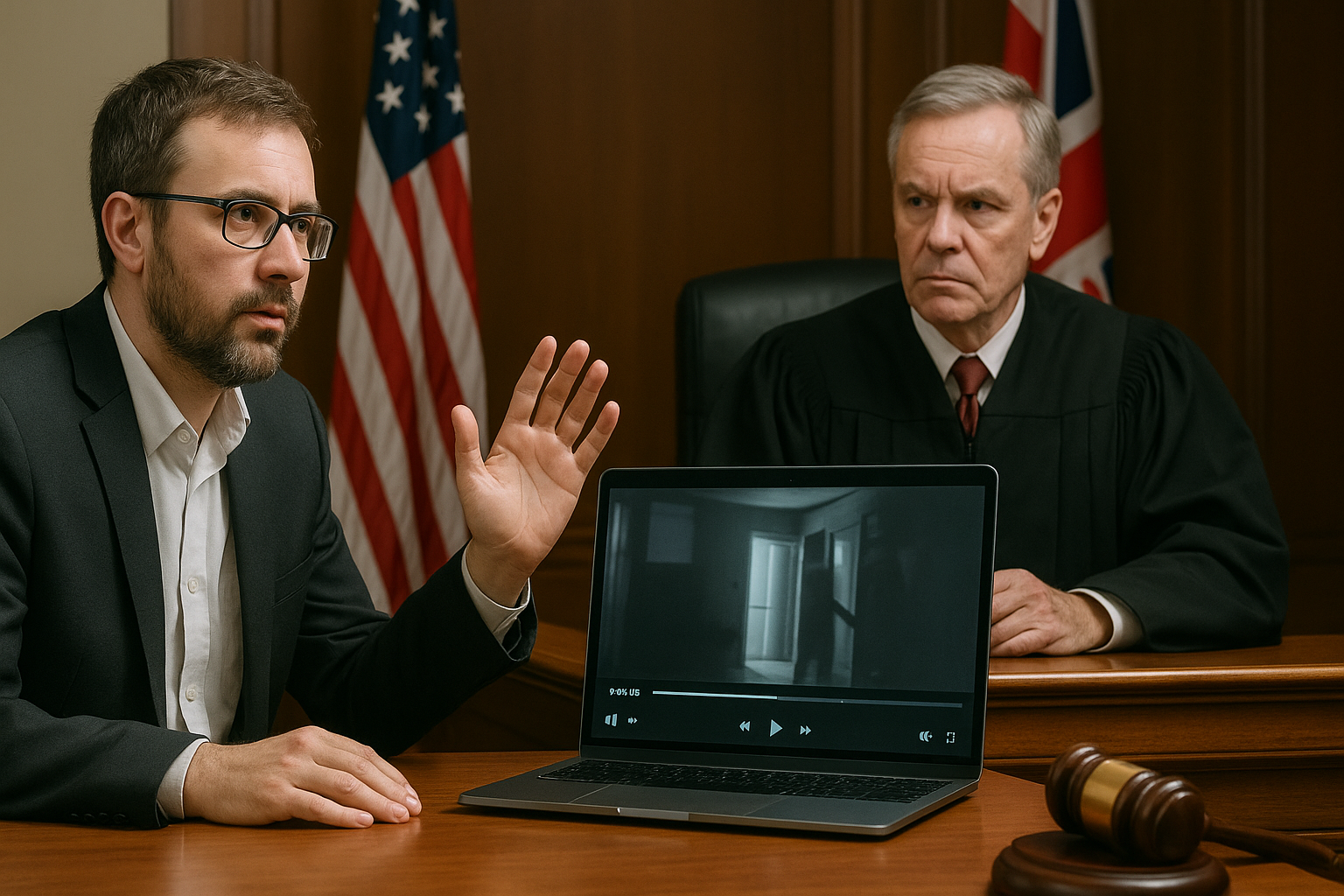
In an era when crime has become effortless, thoughtless and difficult to commit, and over time, technologies have developed that are capable of one click and with absolute ease to reshape reality with a convincing voice and image, digital crimes are no longer limited to hacking or data theft, but have extended to creating fake content that is difficult to distinguish from the truth. Deepfake is one of the most prominent of these new challenges, as it allows the production of fake video or audio clips that may be used for defamation, blackmail, misinformation, and even threatening Community Security, and deepfake has become easier than ever and what is worrying is that society is promoting it, and in front of this accelerated technical development, a fundamental question arises: Are the legal texts in Jordanian legislation sufficient to confront deepfake crimes Or has the digital reality gone beyond the existing legislative framework and imposed the need for more specialized legal treatment?
The legal problem lies in the extent to which the current legal texts are able to accommodate these new crimes, in the absence of explicit texts regulating this crime directly, and relying instead on general texts.
Accordingly, this article aims to study the legal framework for Jordanian deepfake crimes, and to evaluate the adequacy of existing criminal protection in the face of deepfake technology.
First: The legal framework for deepfake crimes in Jordanian legislation
(A) Laws regulating artificial intelligence crimes in Jordan
Despite the development of artificial intelligence and the speed of its spread, there is no legal environment regulating the mechanisms of artificial intelligence in Jordan currently, except the Jordanian strategy for artificial intelligence and the executive plan (2023-2027).
The Jordanian Cybercrime Law No. 17 of 2023 included in its second article multiple definitions that are closely related to the topic of the article. it defined data as everything that can be processed, stored, supplied, or transferred using information technology and technology, including writing, images, numbers, videos, letters, symbols, signals, etc., and also defined the information system – which can be referred to as artificial intelligence technologies- The set of programs, applications, social media platforms, devices, or tools intended to create data or information electronically, send, receive, process, store, manage, or display by electronic means.the cybercrime law also defines programs as a set of technical commands and instructions intended to accomplish an executable task using information systems or any means of Information Technology.
In light of this, some forms of deepfakes can be classified as crimes stipulated in the Jordanian Cybercrime Law, especially those related to defamation crimes, which are defined in Article 188 of the Jordanian Penal Code as: “Attributing a specific article to a person, even if in the context of doubt and questioning, that would undermine his honor and dignity or expose him to people’s hatred and contempt, whether that article is a crime that requires punishment or not.”
Insults are defined in the same Article 188 of the Penal Code as: “assaulting the dignity, honor, or reputation of others, even in the context of doubt and questioning, without stating a specific article “. The derogatory term consists of directing insults, actions, or words at a person with the intent to degrade his dignity or undermine his reputation in front of himself or others, or even assassinating a person, which is defined as: “killing a legal person while his body is still alive.” This is done by creating a mental image that is completely different from what the person is famous for. If this person is famous for his clean hands, and then rumors are raised about him that he is involved in financial scandals, then by this definition he becomes a victim of moral assassination, which contributes to increasing the severity of his influence, and may make him appear in the eyes of people as a corrupt or bad person for a reason, through electronic means, where fake content is used to offend individuals or harm their reputation.
Not only is this technology offensive, but it can also be used to commit fraud and extortion crimes. Criminals have exploited this technology to carry out massive fraud operations; for example, they used a fake voice to convince a bank manager in the United Arab Emirates to transfer $35 million to offshore accounts.
(B) Deepfakes in Jordanian Cybercrime Law
Since these crimes are considered cross-border crimes and are committed in cyberspace, the law concerned with regulating them is the Cybercrime Law, which we will talk about its relationship to the crime of deepfakes, whether it regulates it or not.
In view of the legal texts of Cybercrime Law No. 17 of 2023, Article 3, Paragraph C states:
Anyone who intentionally enters or accesses a website to change it, cancel it, destroy it, modify its contents, occupy it, encrypt it, stop it, disable it, impersonate it, or impersonate its owner shall be punished by imprisonment for a period of not less than three months and a fine of not less than (600) six hundred dinars and not more than (3000) three thousand dinars.
Article 6 states: Anyone who intentionally enters, publishes, or uses a program or software command through the information network or an information technology means or using an information system shall be punished for canceling, deleting, adding, destroying, disclosing, damaging, blocking, encrypting, modifying, changing, transferring, copying, capturing, or enabling others to view data or information, or obstructing, jamming, stopping, or disrupting the operation of the information system Or accessing it, changing a website, canceling it, destroying it, modifying its contents, or occupying it without a permit or in a manner that exceeds or contradicts that permit, or impersonating its character or impersonating its owner, by imprisonment for a period of not less than six months and a fine of not less than (2,500) two thousand five hundred dinars and not more than (10,000) ten thousand dinars.
It is clear from the previous texts of the Jordanian Cybercrime Law No. 17 of 2023 that it mentioned the word using programs to modify, but this work was limited to modifying a website and did not address the use of artificial intelligence techniques to make a change in reality or cause harm to a person using deepfake techniques.
But by approximating these legal texts, it is possible that Article 6 of the Cybercrime Law falls within the scope of the meaning of deepfakes, which referred to impersonation, which means that a person seizes some of another person’s personal data, and then uses that information to impersonate the other person for financial or other purposes”
However, Article 15 of the same law stipulates: Anyone who intentionally sends, retransmits, or publishes data or information via the information network, information technology, information system, website, or social media platforms that contain false news targeting national security and societal peace, or slander, or defamation, shall be punished Or humiliating any person by imprisonment for a period of not less than three months or by a fine of not less than (5,000) five thousand dinars and not more than (20,000) twenty thousand dinars, or by both of these penalties.
Article 16 of the same law also stipulates: Anyone who intentionally and unlawfully spreads, attributes, or attributes to a person, or contributes to doing so through the information network, information technology, information system, or website Or social media platforms, acts that could assassinate his personality shall be punishable by imprisonment for a period of not less than three months or a fine of not less than (5,000) five thousand dinars and not more than (20,000) twenty thousand dinars, or by both of these penalties.
It is clear from the previous texts of the Jordanian Cybercrime Law No. 17 of 2023 that it mentioned the word “rumor,” the word “consolation,” and the word “attribution,” acts that could assassinate a person. This means that we can include them among the cases of deepfakes. However, it would be better for the legislator to have specific, direct texts to criminalize these acts using artificial intelligence technologies.
Article 13, Paragraph A, Clause 1 of the Electronic Crimes Law also stipulates: Anyone who sends, publishes, prepares, produces, preserves, processes, displays, prints, buys, sells, transfers, or promotes pornographic activities or works using the information network, information technology, or information system shall be punished Or a website with imprisonment for a period of not less than six months or a fine of not less than (3000) three thousand dinars and not more than (6000) six thousand dinars.
It is clear from the previous legal text that once you have processed the pornographic clips. It is considered a crime that requires punishment, and it can be included among the forms of deep falsification, specifically pornographic revenge. This act must be committed by a means of modern technology or information systems that we knew previously. The punishment for the same article has also been increased if it was for an event.
Article 17 of the same law states: Anyone who intentionally uses an information network, information technology, information system, or website shall be punished Or a social media platform to publish anything that might incite sedition or strife, or target societal peace, or incite hatred, or call for or justify violence, or contempt of religions, by imprisonment from one to three years, or by a fine of not less than (5,000) five thousand dinars and not more than (20,000) twenty thousand dinars, or by both of these penalties.
This article makes clear anyone who makes any post that would create racism or sedition, which means: It is any intentional act or statement that includes spreading ideas that could harm the security and stability of the state, disrupt public order, spread panic among citizens, incite their money to danger, incite feelings of hatred or contempt for religions, cause strife among members of the nation, incite danger, or disturb the relations of the Jordanian state with another state. Otherwise, using the information system and any other means shall be punishable according to the text of this article, but the Jordanian legislator should have kept pace with modern legislation and organized a special text regarding deepfake technology.
Second: The adequacy of criminal protection in Jordanian law compared to other legislation.
(A) The legal framework for deepfakes in American law
As a result of the threats and risks that deepfake technologies pose to private and public life, legislation in this regard is divided. There are legislations that have addressed deepfake technology in independent laws, such as American states, where 27 states, as of May 2025, issued laws criminalizing the use of deepfake technologies, and issued federal legislation called the TAKE IT DOWN Act, which criminalizes the publication or distribution of non-consensual intimate photos or clips Whether real or produced using artificial intelligence, the platforms are required to remove reported content within 48 hours of notification. The law was passed and signed by President Donald Trump on May 19, 2025. Penalties vary between states, including fines and imprisonment, and the length of the sentence varies according to the seriousness of the crime.
(B) Legal texts of the state of Texas compared to the texts of Jordanian law
Many states have already passed or are considering legislation to regulate deepfakes, criminalizing the falsification of videos to influence electoral processes, for example, Texas has enacted two major criminal laws to address the phenomenon of deepfakes:
First Criminal Law:
Law (SB 751 2019)– on deepfakes in election campaigns which states:
d) Anyone who, with the intention of harming a candidate or influencing the outcome of the elections, does the following:
Create a deep fake video;
Causing the publication or distribution of deep fake video within thirty days of the election.
e) In this article, “deep fake video” means video created with the intent to deceive, and which appears to depict a real person performing an act that did not occur in reality.
This crime is classified as a first-degree misdemeanor, which may be punishable by up to one year in prison and a fine of up to $4,000.
Comparing it to the text of Article 16 of the Jordanian Cybercrime Law, we find that both laws require criminal intent, and that character assassination in general is a political crime, thus sharing the same meaning as the text of the Texas law. However, the difference is that Jordanian law focuses on protecting individuals from slander and defamation, while Texas law focuses on protecting the electoral process resulting from the negative use of deepfake technologies.
Second Criminal Code:
Article 21.165: Related to the illegal production or distribution of some explicit sexual videos, which was implemented on 01\09\2023, and stipulates:
a) In this article:
1.”Deepfake video” means a video created with the intent to deceive, and which appears to depict a real person performing an act that did not actually occur.
2.”Intimate parts” and “sexual behaviour” have the meanings set out in Article 21.16.
(b) A person is considered to have committed a crime if, without the effective consent of and with the knowledge of the person shown in the video, he produces or distributes a deepfake video via electronic means, in which that person appears to have his intimate parts exposed or to be engaged in sexual behaviour.
(c) The crime stipulated in this article shall be classified as a first-degree misdemeanor.
(d) If an act which constitutes a crime under this Article also constitutes a crime under another law, the perpetrator may be prosecuted under this Article or under that other law.
Comparing it to the text of Article 13 of the Jordanian Cybercrime Law, we find that the difference between it and the Texas law is that the Texas law focused on deep-seated pornographic forgery technology, unlike the Jordanian law, which focused on criminalizing a group of acts related to pornographic content via electronic means.
Proposals: The role of the state and society in confronting deepfakes
From our perspective, deepfake applications are a time bomb with significant risks, and it is imperative that we address them firmly. On the political front, governments can adopt strict measures to combat the spread of false and fabricated news. Alternatively, countries can offer attractive financial rewards to anyone who encounters fake clips, encouraging experts and ordinary people to do more to reduce this fake mess. On the social level, it is important for societies to put pressure on individuals not to be carried away by these shameful acts. There is no applause for those who put the facts under their feet, and no support for those like them who exploit famous symbols to turn them into tools of fraud and deception. Moreover, in recent years we have seen how artificial intelligence has become a major driver in the process of manipulating facts. Our excessive reliance on this technology, even to amplify seemingly simple things in our daily lives, has clear negative repercussions. Every system we seek to build requires strict security measures, and as technology and artificial intelligence become more deeply embedded in our lives, the risks also become more acute, not just in the short term, but even in the long term.
Thus, here I must point out that the current legal framework does not deal with deepfakes as a separate crime, but rather addresses their consequences or the actions associated with them within general texts that are not sufficient to limit these crimes, which may pose a threat to political stability and a social threat such as deep pornographic revenge, which is one of the social risks And also the economic threat that could cause small or large companies to incur large financial losses, which affects the economy.
Conclusion
Artificial intelligence technologies have clearly contributed to the development of deepfake technology and its use in positive areas that serve the individual and society. However, this technology has undermined public confidence in the credibility of what they see and hear, as the gap between truth and illusion is gradually blurring in the digital space. There is no doubt that there are growing fears that this potential may be exploited in the future for malicious purposes that affect the security of individuals and the safety of society.Addressing the dangers of deepfakes requires concerted efforts at multiple levels.
Accordingly, the article recommends that to address this phenomenon, it is necessary to have special and explicit texts that criminalize deepfake technology, and to have special legal texts that address the types of crimes and the punishment for each of them, and the value of compensation for the damages resulting from each criminal act, and also to establish specialized official technical departments that seek the assistance of judges and lawyers in any case in which there is suspicion, and finally to conduct awareness campaigns about the dangers of using this technology And holding introductory seminars to prevent anyone from falling into its grip or meaning.
Reference(S):
Legislation
Cybercrime Law No. 17 of 2023 (Jordan).
Penal Code Law No. 16 of 1960 (Jordan).
Secondary Sources
Mohammad Mahdi Al-Ajmi, The Crime of Identity Impersonation on SocMedia Sites: A Comparative Jurisprudential Study with Kuwaiti Law, 37 J. Sharia & Islamic Stud. 130 (2022).
Ashraf Fathi Al-Rai, Cyber Crimes: Substantive Provisions of Information Technology and Artificial Intelligence Crimes 201 (Dar Al-Badeel Publ’g & Distrib. 2025).
Ahmad Barak, Towards Regulating Artificial Intelligence Technologies 30 (1st ed., Dar Wael Publ’g 2022).
Gov’t of Jordan, Jordanian Artificial Intelligence Strategy and Executive Plan (2023–2027) (2023).
Jordanian Court of Cassation, Decision No. 1634/2020 (2020).
New Federal Law Criminalizes Deepfake and Nonconsensual Porn, Religion Unplugged, https://religionunplugged.com/news/2025/5/21/new-federal-law-criminalizes-deepfake-and-nonconsensual-porn
Deepfakes, Varghese Summersett, https://versustexas.com/blog/deepfakes/ (last visited May 19, 2026).
LegiScan, https://legiscan.com (last visited May 21, 2026).