Authored By: Agrim Vashistha
Unity PG and Law College, Lucknow University
India is a country of extraordinary contradictions. It is world’s largest democracy. And still, it is governed by covers of personal laws which are rooted in religion and community. A Muslim man and a Hindu man may live in the same colony, work at the same place, and share the same citizenship. But, when it comes to inheritance, marriage, adoption, divorce, etc, they are treated differently, and are governed by different legal systems. This all is the fruit of the seed of our country’s history, politics, and set of constitutional choices which were made decades ago.
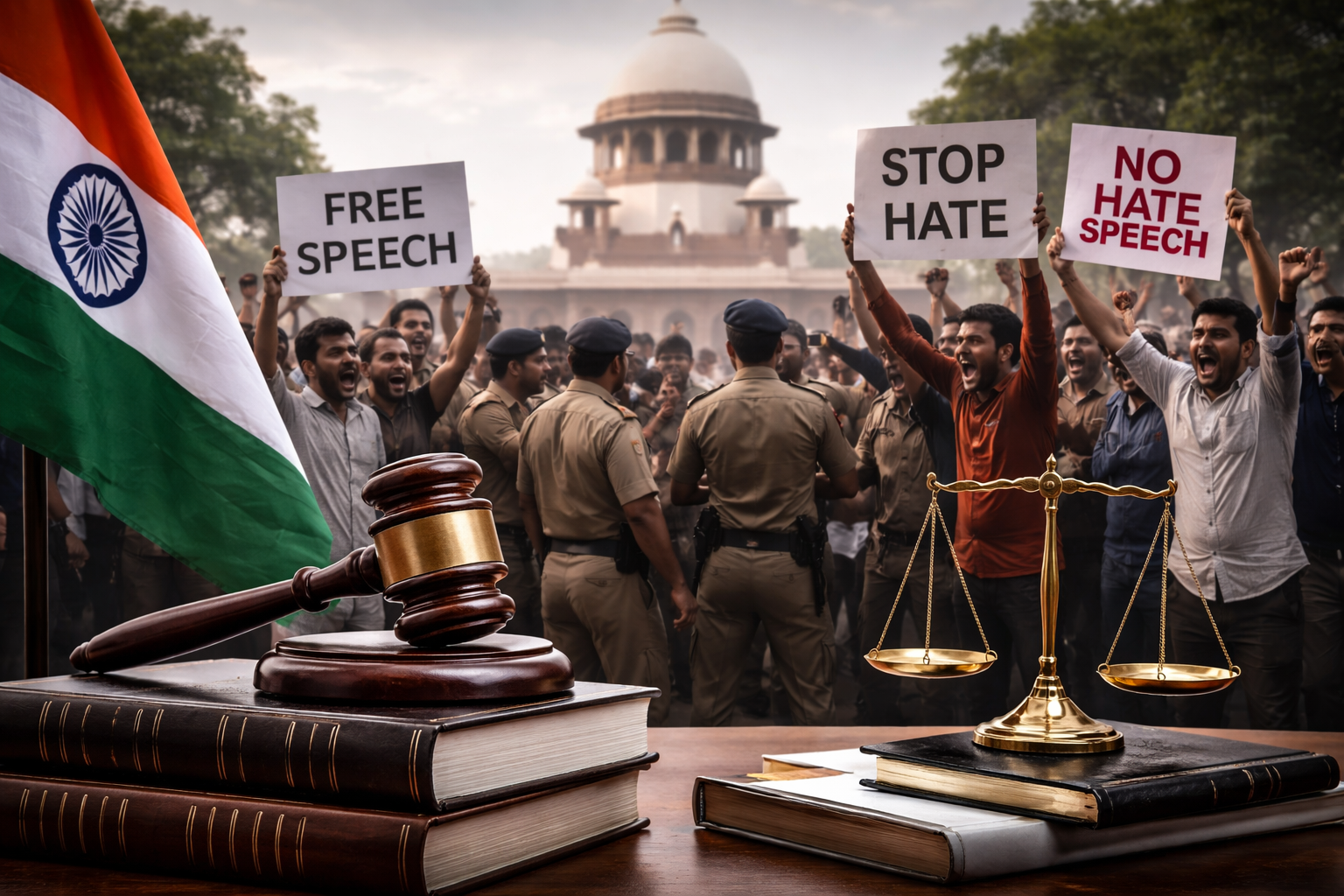
Basically, Uniform Civil Code is a proposal to replace all the different religion based personal laws and applying a secular code to all citizens regardless of their religion, colour, caste or creed. When discussing, it sounds like a straightforward, practical idea. But, in reality, it is one of the most complicated and contested idea within Indian territory nowadays. A lot is discussed and debated about it almost everyday. News channels, newspapers, general public at a tea stall, employees of corporate houses, and etc. Everyone listens about it, everyone talks about it, and everyone has an opinion about it. And we can say that this is happening because, this topic simultaneously touches on everything, like, constitutional values, religious freedom, gender justice, minority rights, and the very nature of what it means to be Indian.
The Historical roots: Where did this debate begin?
To understand about all this debate, we have to go back to the making of Indian Constitution. The question of UCC also existed when the Constituent Assembly met between 1946-1949 to draft the foundational document of the new nation.
The makers of the Constitution knew about the complexity and difficulty of the task. At that point of time, India had just been divided by Partition because of religious issues. But, the country was still home to several religions and sects. Hindus, Muslims, Christians, Sikhs, Prarsis, and bunch of more communities were residing in India, each with their own traditions, customs, and old practices.
Some members of the Constituent Assembly, most importantly, Dr. B.R. Ambedkar, argued for Uniform Civil Code. H e believed that personal laws based on religions will not be just for the upcoming society of Independent India. He believed that personal laws were deeply unjust and that a new, independent, modern, and most importantly, secular republic could not allow religions to determine people’s civil status. H e saw UCC as essential to both equality and national unity.
But, others, including many Muslim members of the Assembly were strongly against UCC. They said that personal laws cannot be separated from the religious identity and UCC would make some kind of religious and cultural dominance of some people, over other minorities of India. This was a long run debate, going through many intense and hard phases, ultimately unresolved and shelved.
Later on, the UCC was included in the Constitution of India, but not as a fundamental right, but as a Directive principle of State policy under Article 44. This placement was significant.
The Constitutional Framework: Rights, Principles, Tensions
For understanding the UCC debate, we should first understand that how it sits in the constitutional architecture.
“Article 44” and the DPSPs represent the long term goals and the idea of the way of functioning of the Indian state. They include directives regarding several things, be it equal pay, environmental protection, etc. But, in between all these also lies an important and crucial part, Uniform Civil Code. Though they can not be enforced by courts, but Supreme court has stated this many times, that, the directive principles should be considered fundamental to governance and must be read alongside Fundamental Rights.
But, here comes the main part of tensions : On one hand, Article 25 and Article 28 of the Constitution of India guarantee freedom of religion (the right to profess, practice, and propogate one’s faith). Opponents of the UCC argue that imposing a uniform code would violate these guarantees by overriding religiously mandated personal laws. And, on the other hand, Article 14 gives equality before law and equal protection of the laws. Article 15 prohibits discrimination on the grounds of religion, race, caste, sex, or place of birth. Critics of the existing system argue that allowing different personal laws for different communities and religions is itself discrimination. For example, A muslim woman’s rights to maintenance or inheritance and a Hindu woman’s right to maintenance or inheritance can’t differ because of their religion.
And we should not forget about the Article 13, which makes any law inconsistent with Fundamental Rights void. SO, here comes a long debated question, that, will personal laws also come under this, and if yes, then shouldn’t they be struck down for violating equality rights.
This question has been there since ages. The courts have also wrestled with this question for decades without fully resolving it.
The Judiciary Speaks : Supreme Court Observations Over the Decades
As mentioned above, in the previous section, our judiciary has wrestled with this issue for ages. But, interestingly, The Supreme Court of India has mentioned the need of a Uniform Civil Code and, obviously, how consistently the Parliament has declined to act on those observations. Here is a bit of an overview about what I am talking about.
SHAH BANO (1985)
Most people associate to this case and it’s debate. Mohammad Ahmed Khan v. Shah Bano Begum concerned a 62 year old Muslim woman who had been divorced by her husband of 43 years, Advocate Mohammad Ahmed Khan, through triple talaq and sought maintenance beyond the period prescribed under Muslim Law. The Supreme Court held that Bano was entitled to maintenance under the secular provisions of code of civil procedure. In a landmark passage, Justice Yashwant Vishnu Chandrachud’s majority judgment observed that a uniform civil code would help the nation by eliminating the divisions caused by different communities following conflicting rules. The judgment explicitly called on Parliament to enact a UCC.
That fallout was sudden and severe. The government of Rajiv Gandhi, anxiously and hastily passed the Muslim Women (Protection of Rights and Divorce) Act, 1986, which overturned the Shah Bano ruling.
SARLA MUDGAL V. UNION OF INDIA (1995)
It arose from troubling practice of Hindu men converting to Islam to marry more than one woman. The Supreme Court found this practice wrong and unethical. Supreme Court called this activity an abuse of religious conversion freedom. So, the SCI again insisted for the enactment of Uniform Civil Code.
SHAYARA BANO V. UNION OF INDIA (2017)
This is a historic verdict by the Supreme Court of India. The Supreme Court declared the practice of ‘Triple Talaq’ or ‘Talaq-ul-biddat’ unconstitutional. The Supreme Court announced that Triple Talaq is arbitrary and violative of Article 14. Many people think that the case did not directly concern UCC, but, if noticed carefully, then the verdict represented the Indian Judiciary’s continued willingness to examine and reform the personal laws against constitutional standards of equality and dignity.
These all cases shows clearly that the Supreme Court of India has repeatedly identified the absence of a Uniform Civil Code, and highlighted it as an important decision which should be taken ASAP. The Supreme Court of India has repeatedly called on the legislature to act on this. But, on the other hand, the legislature has not taken any step towards it, continuously ignoring the advice of the Supreme Court of India.
Why supporters believe in the Uniform Civil Code
The supporters of Uniform Civil Code make arguments about equality, justice, and the kind of republic India should aspire to be.
‘Equality Before the Law’ is perhaps the most fundamental argument. In most areas of law, like, Criminal law, Contract law, Tax law.
Why, proponents ask, should the intimate domains of marriage, divorce, and inheritance be any different? A secular republic, they argue, cannot claim to treat its citizens as equals if it governs them by different rules based on religious affiliation.
‘Gender Justice’ probably presents the most powerful argument. In India, different groups of people follow different religious rules (laws) for things like marriage and family. Sometimes, these old rules are unfair to women and treat them differently than men. Under traditional Hindu law, the right to inheritance in property was not given to women. Earlier, Christian women were required to prove adultery with some other grounds too for divorce from their husbands. Uniform Civil Code’s supporters say that it would set a system of equal rights for all the women regardless of which religious community, or sect, or caste they belong to.
‘National Integration’ is the strongest point of argument among all. This point echoed most strongly with the people of India. A country or a state whose people are governed by different civil laws based on their religion (Personal laws), caste (caste-based reservation’s constitutional mechanism), and etc. is basically a divided state. If there will be a common legal framework for all civil matters, then there will be a shared civic identity for all, hence, automatically reducing the importance and influence of religious community as a determinant of legal status regarding any matter in the society.
In short, after Uniform Civil Code’s application only, every person will be EQUAL in the right sense.
‘Simplification and Clarity’ are among the most important things, but often gets overlooked in the more heated constitutional debate. Nowadays, we have several personal laws, overlapping each other and other public civil laws too. Almost every religion’s personal laws exist in our country. Hindu law, Muslim law, etc, each with it’s own subcategories too. This all just makes the things and issues more complex and is even more bewildering for lawyers and judges.
A single, combined code of law, made for every person of the country, keeping in mind everyone’s needs and sentiments too, would make the law more accessible, simpler, and predictable for ordinary citizens.
Why critics are concerned and are against The Uniform Civil Code
The arguments against Uniform Civil Code are also at a strong position. They raise genuine issues about pluralism, power, and the limits of state authority.
‘Religious Freedom and Cultural Diversity’: Opponents argue that personal laws are deeply tied to religious identity, scripture, and tradition, not just legal rules. Critics believe the state should not force uniformity on matters that are meant to be culturally unique. They emphasize that the Constitution protects the right to practice religion, which for many, includes following their specific personal law.
‘Minority Concerns’: These are especially acute in the Indian context. For Muslims in particular, the Uniform Civil Code debate also carries majoritarian dominance. If the uniform code in practice draws heavily on Hindu legal traditions, then there are chances that majority’s ideas can be imposed on minorities. And this is the very things that the Constitution’s protections for religious freedom were designed to prevent. And, let me be clear, these mentioned concerns are not hypothetical. The political personalities who are most vocal about the Uniform Civil Code have often been associated with Hindu Nationalist politics, which leads to doubts and suspicions about the real motive for the support of uniformity.
‘Practical Difficulties’: India’s religious communities are divided within themselves too. For example, Within Islam alone, there are Shia and Sunni traditions with the different rules. More examples are as follows, Within Christianity, Catholic and Protestant practices differ. So, just imagine, how tough task it would be to codify reconcile all these diverse traditions, religions and their sects into a single coherent code. How will the government manage to make a uniform law for communities with such radically different inheritance traditions?
What would a uniform law of inheritance look like across communities with poles apart ideologies?
‘Forced Homogeneity’: This is the biggest fear in everyone’s mind. Even if they support the Uniform Civil Code, they still can not deny that this issue exists. India is known for it’s diversity, it’s multiple languages, it’s multiple religions, it’s multiple customs, and it’s multiple traditions. These all have been described as India’s strength several times. India is known for “Unity in Diversity”. That’s why, the critics of the Uniform Civil Code thinks, that, uniformity, however well-intentioned, can lead to the destruction of a complex cultural landscape in the name of a legal tidiness that serves administrative convenience more than genuine justice.
A global perspective; How other countries navigate this question
India is not the only country who have faced a situation like this, where the personal religious laws and Uniform Civil Code come in a face-off.
- TURKEY, under Mustafa Kemal Ataturk, adopted a civil code in 1926, throwing off the Ottoman Islamic Law in favour of a secular legal framework.
- FRANCE, has been a republic since ages and the law of France is uniform and applies to everyone equally. There is no room for religious personal laws in France.
- ISRAEL, gives us a bit different, but an interesting perspective. Despite being a Jewish state, Israel maintains separate religious courts too. Jewish, Muslim, Christian, and Druze with jurisdiction over personal status matters for members of their respective communities. This system has been widely criticized for its effects on women.
- UNITED KINGDOM, is walking the middle path. While English law is formally uniform, unofficial Sharia councils and Jewish courts operate alongside.
These examples show that the relationship between religious law and civil uniformity is everywhere. And there is no single uniform model which we can look up to for resolving all problems.
We people have to understand one thing, till the day humans exist, problems will exist too, hand in hand. The solution is trying to look up to the problems and try to resolve them.
What future holds: Gradual Reforms and Justice
The UCC debate in India resists easy resolution because there are genuine points on both the sides.
The Uniform Civil Code (UCC) debate is complex, balancing equality and pluralism. A constructive path forward requires:
- Prioritizing justice over mere uniformity: Focus on eliminating inequalities in personal laws, particularly those affecting women, rather than just imposing a singular code.
- Inclusive process: A legitimate UCC must emerge from broad deliberation involving women and minorities to avoid backlash.
- Piecemeal reform: Targeted legislative changes (like abolishing triple talaq) are often more durable and effective than wholesale replacement.
- Secular focus: The UCC should govern only the civil, legal aspects of family life.
Citation(S):
- Ahmed Khan v. Shah Bano Begum (1985) 2 SCC 556 (Y.V. Chandrachud, Misra Rangnath, D.A. Desai, O. Chinnappa Reddy) (India).
- Sarla Mudgal v. Union of India (1995) 3 SCC 635 (Justice Kuldip Singh, Justice R.M. Sahai) (India).
- Shayara Bano v. Union of India (2017) 9SCC 1 (Chief Justice J.S. Khehar, Justice S. Abdul Nazeer, Justice Rohinton F. Nariman, Justice Uday U. Lalit, Justice Kurian Joseph) (India).
- INDIA CONST. art. 14.
- INDIA CONST. art. 15.
- INDIA CONST. art. 25.
- INDIA CONST. art. 44.